
Administrators are responsible for creating new users and assigning them appropriate permissions.
Prerequisite in Entra
-
The user must exist as a user in the tenant (in Entra)
-
There user must be assigned a valid Business Central license in Entra.
-
If no license is available for assignment to the user, contact Wisefish through https://wisefish.atlassian.net/servicedesk/customer/portal/28
-
Import users into Business Central
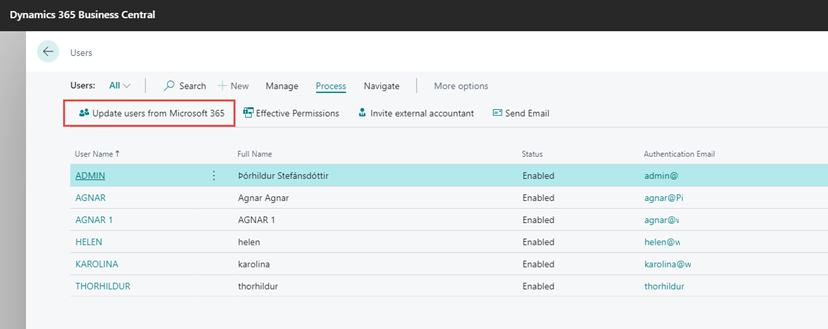
Once the setup of users in Entra is complete, go into Business Central and update the users there. To import the user into Business Central, go to the search and search for Users and select the option in the search. Click on Update users from Microsoft 365 to create the user in the list of Business Central users. On the user card, you can set which permissions the user should have and in which company.
Permission Sets
Default permissions out of the box
When a new user is added to Business Central, they automatically get the default permission sets that belong to their Microsoft license (for example Essential, Premium or Team Member). Administrators can change these defaults on the License Configuration page. Search for Licenses, choose the license and set which permission sets new users get.
The main user of the system has the permission SUPER. SUPER users have permissions to everything in the system. It is not desirable that all users have SUPER privileges. You can choose from permission sets for each user on the user panel.
Each set of permissions needs to be carefully considered before defining it for a user. You can define permissions to different companies. If an employee is to handle wages in company A but not in company B, you can define this by selecting Company in the source line.
Wisefish permission sets
Wisefish ships with its own predefined permission sets that cover the Wisefish functionality, such as [e.g. WF-BASIC, WF-PRODUCTION, WF-SALES, WF-QUALITY, WF-ADMIN]. To find them:
-
Search (Alt+Q) for Permission Sets.
-
Filter the Permission Set column on *[WF]**, or filter Extension Name on Wisefish.
-
Select a set and choose Permissions to see exactly which objects it gives access to.
Wisefish permission sets are usually combined with Microsoft’s standard sets. For example, a production user might get [WF-PRODUCTION] together with D365 BASIC and D365 ITEM, VIEW.
Assigning permissions to a user
Permissions are assigned on the User Card:
-
Search for Users and open the user.
-
On the User Permission Sets FastTab, add a line for each permission set the user should have.
-
In the Company field, choose the company the permission applies to. Leave it blank for the permission to apply to all companies.
Think through each permission set before you give it to a user. You can also give different permissions in different companies. For example, if an employee handles wages in company A but not in company B, add the payroll permission set with Company = A only. If a set should apply to several companies but not all, add one line for each of those companies.
To see the result, choose Effective Permissions on the User Card. It shows what the user can actually do and which permission set gives each right.
Security groups (recommended for multiple users)
Instead of giving permissions to each user one at a time, you can use security groups. A security group is linked to a group in Microsoft Entra ID (Azure AD) or, on-premises, a Windows Active Directory group. Users get the group’s permissions automatically when they’re added to the group in Entra ID.
-
Ask your IT administrator to create the group in Microsoft Entra ID (for example BC – Production) and add the right users to it.
-
In Business Central, search for Security Groups and choose New.
-
In the Microsoft Entra security group name field, select the group.
-
Choose Permissions and add the permission sets the group should have. Use Add multiple to add several at once. Set Company if the permissions should only apply to one company.
When an employee changes roles, you only need to move them to another group in Entra ID. You don’t need to change their User Card.
Creating your own permission sets
If the predefined sets don’t fit, you can make your own. We recommend starting from an existing set instead of from scratch:
Copy an existing set (recommended)
-
On the Permission Sets page, select a set (for example a Wisefish set) and choose Copy Permission Set.
-
Give the new set a name, for example [CUSTOMER-PRODUCTION].
-
Choose a copy option. Copy by reference keeps a link to the original, so Microsoft and Wisefish updates are applied automatically.
-
Open the new set and add or exclude permissions as needed.
Build a new set
-
On the Permission Sets page, choose New, then enter a name and description.
-
Choose Permissions. In the Permission Sets pane, add existing sets that the new set should include.
-
Add individual objects with Read, Insert, Modify, Delete and Execute rights. Choose Yes for full access or Indirect for access only through a related process, such as posting.
-
Use Exclude to remove rights you don’t want to include from the added sets.
Record permissions
You can also choose Record Permissions → Start on the Permissions page and then carry out the tasks the user should be able to do. When you choose Stop, Business Central adds the objects you used to the set.
Permission sets can also be exported and imported between environments, for example from a sandbox to production, with Export Permission Sets and Import Permission Sets.
Note: Don’t create your own sets by editing the Wisefish or Microsoft system sets directly. Always copy them, so your changes aren’t lost when the system is updated.
Further reading (Microsoft Learn)
Manage user settings and preferences
As an administrator, you can configure user settings in Business Central, similar to how individual users can manage their own preferences in the My Settings page.
Select the user, then click on User Settings

The User Settings card page is similar to the My Settings page that each user has access to, and it's a powerful tool for you as the administrator for setting default settings and clearing personalized pages, for example.
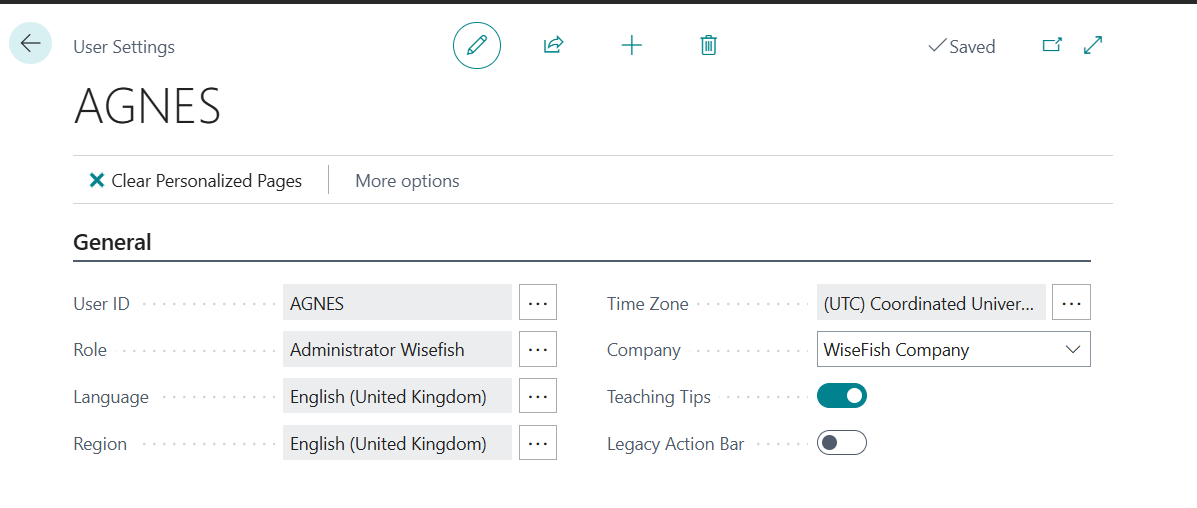
💡 It is important that users have the correct region and time zone. See information here: https://learn.microsoft.com/en-us/dynamics365/business-central/admin-manage-user-settings-preferences
User Setup and Wisefish Profile
Every Wisefish user must have a WF User Profile. The profile holds the user’s default Wisefish settings, such as stock center, location and default values used in the Wisefish modules. These settings control how Wisefish pages and workflows behave for the user.
You can use one profile for all users, or create several profiles for different roles, for example production, sales and quality. Each user is then linked to the profile that fits their work.
To assign a WF User Profile to a user:
-
Search (Alt+Q) for User Setup.
-
Add a line with the user’s User ID, or select the existing line.
-
In the WF User Profile Code field, select the profile.
The User Setup page is also where you set standard Business Central settings for the user, such as the dates they are allowed to post in.
For instructions on creating WF User Profiles and a description of all profile fields, see User Profiles.
Some Wisefish modules, such as Quality, Logistics and Wisefish Stream, have their own fields on the WF User Profile. When you set up users for these modules, see the user guide for each module in the Wisefish Manuals.
Note: The WF User Profile and the Business Central Profile (Role) are not the same thing. The WF User Profile holds the user’s Wisefish default settings. The Profile (Role) decides which Role Center and menus the user sees, and users can change it themselves in My Settings. For more information, see Manage users and roles on Microsoft Learn.